
Welcome to Emston Tech, One Stop Shop For All Your Solar Needs!
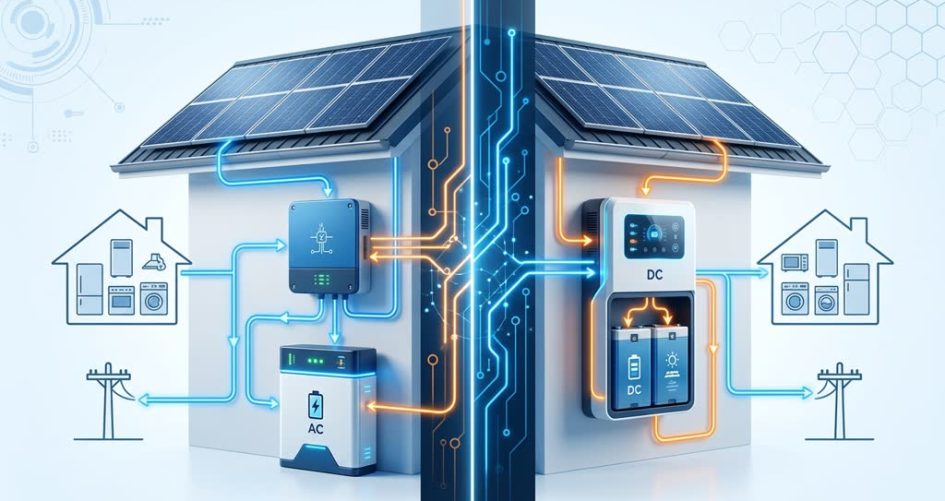
Adding battery storage to an existing solar system can help homeowners and businesses use more of their own solar energy, improve backup power options, and manage electricity usage more effectively. However, choosing the right battery architecture is an important decision. The two main approaches are AC-coupled and DC-coupled battery systems.
For a solar retrofit project, the choice is usually not about finding one technology that is always better. Instead, it depends on the existing solar equipment, inverter compatibility, backup goals, installation complexity, and future expansion plans. AC-coupled systems are often considered when adding batteries to an existing PV system, while DC-coupled systems are commonly selected when solar and storage are designed together from the beginning. :contentReference[oaicite:0]{index=0}
This guide explains how AC-coupled and DC-coupled batteries work, their advantages and limitations, and how to decide which option may fit a solar retrofit.
An AC-coupled battery system connects the battery storage system on the AC side of the solar installation. The existing solar panels continue sending electricity through the original solar inverter, while the battery uses a separate battery inverter to charge and discharge.
In a typical AC-coupled setup:
The main advantage of this design is that it can often be added without replacing a functioning solar inverter. This makes AC coupling a popular approach for retrofit projects where the solar array is already installed and operating. :contentReference[oaicite:1]{index=1}
A DC-coupled battery system connects the battery and solar array on the DC side, usually through a hybrid inverter that manages both solar generation and battery storage.
In a DC-coupled system:
Because solar energy can move directly between the PV array and battery before being converted to AC, DC coupling may reduce some conversion steps in certain operating conditions. However, adding DC-coupled storage to an existing solar system may require replacing equipment or redesigning parts of the installation. :contentReference[oaicite:2]{index=2}
| Feature | AC-Coupled Battery | DC-Coupled Battery |
|---|---|---|
| Connection point | Battery connects on the AC side of the system | Battery connects on the DC side through compatible equipment |
| Existing solar inverter | Often can remain in place | May require replacement with a hybrid inverter |
| Retrofit complexity | Generally simpler for existing PV systems | Can require more system changes |
| Solar and battery coordination | Managed across AC connections | Managed through shared DC-side controls |
| Common application | Adding storage to an existing solar installation | New solar-plus-storage designs |
When a solar system is already installed, the biggest question is often: How much of the existing system needs to change?
Many retrofit projects have working solar panels, a functioning inverter, and an established electrical connection. Replacing those components just to add storage may increase project complexity.
AC-coupled batteries can provide a practical solution because the battery system operates alongside the existing PV equipment rather than replacing it. This approach may allow:
However, every installation must be evaluated for inverter compatibility, electrical requirements, backup configuration, and local regulations.
Although AC coupling is often attractive for retrofits, DC coupling has important benefits when the system design allows it.
Solar panels and batteries both operate using DC electricity. A DC-coupled system can allow solar energy to charge the battery without first being converted to AC and then converted back to DC. Depending on the equipment and operating conditions, this can improve energy flow efficiency.
Hybrid inverters used in DC-coupled systems can coordinate solar production, battery charging, and household loads through one central device.
When installing solar and storage at the same time, DC coupling can simplify system design because the inverter, battery, and solar array can be selected as a complete package.
If the current solar inverter is relatively new and operating properly, replacing it may not provide enough benefit to justify the additional work. AC coupling may allow the existing system to continue operating.
Battery systems designed for backup power require careful planning. The inverter, battery capacity, critical loads, and electrical equipment must all work together correctly.
If additional solar capacity or battery storage may be added later, the system architecture should support those plans.
Not every battery works with every inverter. Always check manufacturer compatibility requirements, voltage ranges, communication protocols, and installation guidelines before selecting equipment.
| Question | Why It Matters |
|---|---|
| Is the existing PV inverter still suitable? | Determines whether keeping the current solar system makes sense. |
| Is battery backup required? | Affects inverter selection and electrical design. |
| Will more solar or storage be added later? | Helps determine future system flexibility. |
| Are the battery and inverter compatible? | Ensures proper operation and safety. |
For many existing solar installations, an AC-coupled battery system can be a practical retrofit option because it allows storage to be added without completely redesigning the solar system. DC-coupled systems can be highly effective when replacing the inverter, installing new solar, or building a solar-plus-storage system from the beginning.
The right choice depends on the details of the project. Before selecting a battery system, review the current solar equipment, energy goals, backup requirements, and long-term plans with a qualified installer or system designer.
AC coupling is often considered for existing solar systems because it can allow the original PV inverter to remain in operation. However, the best choice depends on the equipment already installed and the project requirements.
It is possible in some cases, but it may require replacing the existing inverter with compatible hybrid equipment and making additional electrical changes.
DC coupling can reduce some conversion steps during solar charging, but real-world performance depends on the specific inverter, battery, controls, and operating conditions.
Yes, many AC-coupled battery systems can provide backup power when designed with compatible battery inverters and backup equipment.
Homeowners should review inverter compatibility, battery capacity, backup needs, electrical requirements, warranties, and future expansion plans before choosing a storage system.
Emston Tech helps customers understand solar equipment options and storage technologies so they can make informed decisions when planning solar upgrades and battery installations.