Welcome to Emston Tech, One Stop Shop For All Your Solar Needs!
Choosing the right solar racking layout can have a major impact on how much energy a photovoltaic system produces and how effectively it uses available space. Two of the most common approaches are south-facing solar racking and east-west solar racking. While south-facing arrays have traditionally been considered the standard for maximizing solar production, east-west designs have become increasingly popular because they can improve roof utilization and spread electricity generation across more hours of the day.
For solar equipment planning, the question is not simply which direction receives the most sunlight. The better question is which layout creates the best overall result for the property. Factors such as roof size, energy consumption patterns, available installation space, battery storage, utility rules, and project goals all influence the best choice.
This guide explains the differences between east-west and south-facing solar racking, how each layout affects production, and what property owners should consider before selecting a system design.
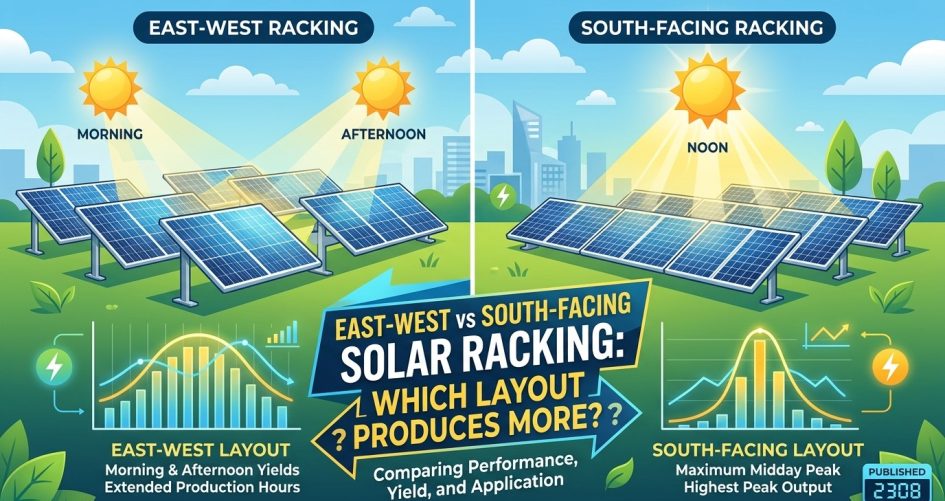
In the Northern Hemisphere, solar panels generally receive the most direct sunlight when they face south. Because the sun travels across the southern portion of the sky throughout much of the year, south-facing panels can capture strong solar exposure during the middle of the day.
For many residential and ground-mounted solar projects, south-facing racking remains a popular choice because it focuses on maximizing energy production from each individual panel. When there is enough open space available, a south-facing design can provide excellent annual energy output.
| South-Facing Racking Factor | How It Affects Solar Performance |
|---|---|
| Panel direction | Panels face toward the southern sky in the Northern Hemisphere. |
| Energy production pattern | Typically creates a stronger midday production period. |
| Space requirements | May require additional spacing between rows to reduce shading. |
| Common applications | Ground mounts, large properties, and suitable pitched roofs. |
| Main advantage | High energy production from each solar module. |
However, maximizing production per panel is only one measure of system performance. A south-facing layout may not always produce the most electricity from a limited roof area because spacing requirements can reduce the number of panels that fit on the site.
East-west solar racking uses alternating panel directions, with some modules facing east and others facing west. This configuration is especially common for flat roofs where maximizing the number of installed panels is often a major priority.
East-facing panels receive stronger morning sunlight, while west-facing panels capture more afternoon sunlight. Instead of creating one concentrated midday production peak, the system distributes generation over a longer part of the day.
| East-West Racking Factor | How It Affects Solar Performance |
|---|---|
| Panel direction | Uses both east-facing and west-facing modules. |
| Energy production pattern | Creates earlier morning and later afternoon production. |
| Space usage | Can allow tighter panel arrangements on flat roofs. |
| Common applications | Commercial rooftops, warehouses, and space-limited installations. |
| Main advantage | Improved use of available roof area and broader production timing. |
Flat roofs create a challenge for traditional tilted solar arrays. South-facing panels usually need spacing between rows so that one row does not shade another when the sun is lower in the sky. This spacing can reduce the total number of modules that fit on the roof.
East-west racking often uses a lower tilt angle and places rows closer together. Although each panel may produce slightly less energy than an ideally positioned south-facing panel, the total system may produce more energy because more panels can be installed in the same area.
The biggest mistake when comparing solar layouts is looking only at the output of a single panel. A solar system is a complete design, and the available installation area can be just as important as panel orientation.
A south-facing panel may generate more electricity individually, but an east-west design may allow a larger number of panels to be installed. The final system output depends on the balance between panel efficiency, orientation, shading, and available space.
| Comparison Category | South-Facing Layout | East-West Layout |
|---|---|---|
| Output per panel | Typically higher under ideal conditions. | Typically lower per panel because of orientation differences. |
| Use of limited roof space | May require more spacing between rows. | Can often fit more panels into the same area. |
| Morning generation | Usually less concentrated in the morning. | East-facing modules provide earlier production. |
| Afternoon generation | Production decreases after the midday peak. | West-facing modules provide stronger late-day production. |
| Ideal situation | Open areas where maximum panel output is important. | Roofs where maximizing panel count is important. |
The amount of electricity a solar system produces is important, but the timing of that production can also affect system value. A property that uses most of its electricity in the morning and evening may benefit from a different production pattern than a property with heavy midday consumption.
East-west arrays naturally spread production throughout the day. This can help match solar generation with real-world electricity usage patterns.
Both east-west and south-facing systems can work well with batteries. The better design depends on when stored energy is needed. A system that produces electricity earlier and later in the day may reduce the amount of energy that needs to be shifted with storage.
Solar batteries, however, do not automatically make one orientation better than another. The complete system design should consider battery size, electricity consumption, and utility policies.
Solar orientation is only one part of the engineering process. A successful installation also requires evaluating the roof structure, mounting method, wind conditions, and equipment compatibility.
Before selecting a racking layout, consider:
Different panel orientations can create different electrical operating conditions. East-facing and west-facing modules receive sunlight at different times, so inverter design must properly manage these variations.
Many solar systems use equipment configurations that allow different panel groups to operate efficiently. Proper design helps reduce losses and ensures the racking system works effectively with the rest of the solar equipment.
East-west and south-facing solar racking both have important advantages. South-facing layouts remain a strong option for maximizing energy production from individual panels, especially when there is enough space available. East-west layouts provide a valuable alternative by improving space efficiency and creating a more balanced energy production schedule.
The best solar design is the one that matches the property’s conditions and goals. A homeowner, business owner, or installer should evaluate the complete picture rather than selecting a layout based only on panel direction.
Emston Tech helps customers evaluate solar equipment options and understand how racking choices affect system performance. By considering available space, energy needs, and installation conditions together, property owners can select a solar layout that supports long-term performance.
Not always. South-facing systems often produce more energy per panel, but an east-west system may install more panels on the same roof area. Total system production depends on the entire design.
Individual panels in an east-west layout may receive less optimal sunlight compared with south-facing panels. However, the complete system can still perform very well when the design improves roof utilization.
Many commercial buildings have large flat roofs where space efficiency is important. East-west racking can allow more panels to be installed without requiring large gaps between rows.
Both layouts can work with battery storage. The preferred design depends on when electricity is produced, when it is consumed, and how the battery is intended to operate.
The right choice depends on roof conditions, energy goals, available space, and electrical requirements. A complete solar design evaluation can compare expected results before installation.