Welcome to Emston Tech, One Stop Shop For All Your Solar Needs!
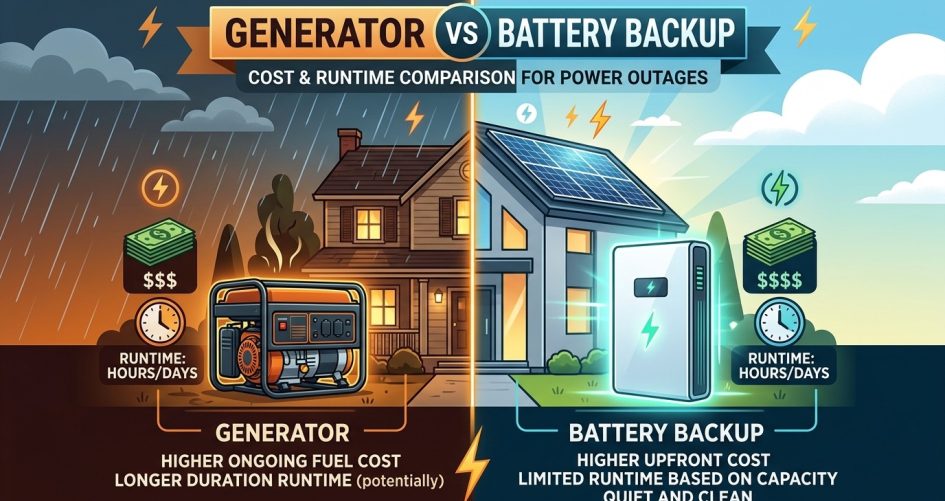
When the grid goes down, you have two main ways to keep the lights on: a fuel-burning generator or a battery backup system. Each one costs money in different places, runs for different lengths of time, and suits different households. This guide compares them on upfront cost, running cost, runtime, and day-to-day practicality so you can choose based on your own outage patterns and your own loads.
A generator converts fuel into electricity for as long as it has fuel and stays mechanically healthy. A battery backup system stores electricity in advance and releases it through an inverter when the grid fails. That single difference, making power on demand versus stored power, drives almost every other tradeoff in this article.
Portable units are moved into position, started, and connected to selected appliances through heavy-duty cords or a properly installed transfer switch or inlet. They are usually the lowest-cost way to get backup power, but they need hands-on operation: fueling, starting, and monitoring.
Standby generators are permanently installed outside the home and connected to a natural gas line or a propane tank. They start automatically through an automatic transfer switch, so they restore power without you doing anything. They require professional installation, permits, and often utility or fuel-line work.
A home battery pairs stored energy with an inverter and a transfer arrangement that isolates your home from the grid during an outage. Most switch over automatically. They run silently, produce no exhaust, and can be installed indoors or in a garage where the manufacturer allows it. Batteries can also be paired with solar panels so they recharge during the day when the grid is down.
Exact prices vary widely by region, brand, size, and installation complexity, so treat any cost comparison as a set of categories rather than a quote. What matters is knowing which line items belong in each budget.
| Cost Item | Portable Generator | Standby Generator | Battery Backup |
|---|---|---|---|
| Equipment | Generally the lowest | Moderate to high | Moderate to high, rising with storage capacity |
| Transfer switch or inlet | Recommended for safe home connection | Required (automatic) | Usually included in the system design |
| Professional installation | Needed for the transfer switch or inlet | Always needed | Always needed |
| Fuel supply setup | Fuel containers and safe storage | Gas line or propane tank | None |
| Permits and inspection | Depends on the electrical work | Typically required | Typically required |
| Possible incentives | Rarely available | Rarely available | Sometimes available, especially when paired with solar; check current local and federal rules |
In broad terms, a portable generator with a transfer switch tends to be the cheapest path to whole-circuit backup, while a large standby generator and a large battery system can both be significant investments. Battery cost is driven mostly by how much energy it stores and how much power it can deliver at once.
Upfront price is only part of the picture. Generators have recurring costs every time they run and every year they sit, while batteries have few consumables but do gradually lose capacity with age and use.
Runtime is where the two technologies differ most. A generator’s runtime is limited by fuel and by how long the engine can run safely between service. A battery’s runtime is limited by stored energy, and by whether you can recharge it during the outage.
A generator can run as long as you keep supplying fuel and follow the maintenance and rest guidelines in the manual. Runtime per tank depends on the fuel tank size, the engine, and how heavily the unit is loaded; running at a lower load generally uses less fuel per hour than running near capacity. Natural gas standby units connected to a utility line may run for a very long time without refueling, provided the gas supply stays available.
Battery runtime depends on two numbers: stored energy, measured in kilowatt-hours (kWh), and the power you draw, measured in kilowatts (kW). A simple estimate is usable kWh divided by the average kW of your backed-up loads, with some allowance for inverter losses. For example, a battery with a given usable capacity will last roughly twice as long if your average load is cut in half. Without solar, the battery will eventually be depleted. With solar, it can recharge during daylight, which can stretch backup across multiple days if you keep your loads modest.
| Factor | Generator | Battery Backup |
|---|---|---|
| What limits runtime | Fuel supply and engine service needs | Stored energy and recharging ability |
| Long multi-day outages | Works if you can keep fueling it | Works best when paired with solar, or with strict load management |
| Short outages | Works, but requires starting and fueling | Works seamlessly, often with no interruption you notice |
| Effect of heavy loads | Higher fuel burn; may overload if undersized | Drains faster; inverter may limit peak power |
| Refill or recharge | Refuel (may need to shut down first for safety) | Recharges from solar or the grid when available |
| Noise | Audible; standby and portable units differ | Essentially silent |
| Exhaust | Produces carbon monoxide; must operate outdoors, away from openings | No exhaust |
Whether you choose a generator or a battery, the most common mistake is buying without knowing what you actually want to power. Sizing starts with a list of loads, not a product page.
Write down what must keep running: refrigerator, freezer, lights, internet router, phone chargers, medical equipment, well pump, furnace blower, sump pump, and so on. Then decide which extras would be nice to have, such as a microwave, washer, or TV.
Motor-driven appliances such as refrigerators, well pumps, air conditioners, and sump pumps draw a surge of power when they start. Nameplates and manuals usually list running and starting (or locked-rotor) values. A generator or inverter must handle both the surge and the continuous draw.
For battery sizing, estimate how many hours per day each load runs and multiply by its power to get kilowatt-hours per day. Add these up to see how much stored energy you would need to cover the outage length you want to plan for. For generator sizing, focus more on peak power, plus how much fuel you can store for the runtime you want.
Central air conditioning, electric heating, electric ranges, electric water heaters, and EV charging can consume a large amount of power. Many backup systems are sized to avoid running these, or to run only one at a time. If you need them, discuss it with an installer before buying anything.
There is no universal winner. The right choice depends on how often you lose power, for how long, what you need to keep running, your budget, and how you feel about noise, fuel handling, and maintenance.
| Your Situation | Likely Better Fit | Why |
|---|---|---|
| Frequent short outages | Battery backup | Instant, quiet switchover with no fueling or starting |
| Rare but long outages, tight budget | Portable generator with transfer switch | Lower upfront cost and can run as long as fuel lasts |
| Long outages and high loads | Standby generator, or a large battery with solar | Higher power capacity and longer endurance |
| Home already has solar panels | Battery backup | Panels can recharge the battery during the day |
| Medical devices that cannot lose power | Battery backup, often with a generator as a second layer | No switchover gap for many systems; discuss requirements with your medical provider |
| Apartment, condo, or limited outdoor space | Small battery or portable power station | Generators need safe outdoor placement |
Yes. Some households use a battery for everyday and short-outage resilience, with a generator as a long-duration backup. Because a generator can recharge a battery, the combination can reduce how often the generator has to run. Compatibility varies by product, so confirm with the manufacturer and an installer that the two will work together and that the wiring is designed for it.
Backup power is only useful if it is used safely. Generators in particular cause preventable injuries every year, most often from carbon monoxide poisoning and improper connections.
If you are stuck between the two, work through these questions in order.
Once you have answers, ask a qualified installer for quotes on your top one or two options and compare them on installed cost, usable runtime for your specific loads, warranty, and maintenance requirements. If you are shopping for solar equipment or batteries, the team at Emston Tech can help you think through the components that fit your needs.
Usually not upfront. Portable generators tend to have the lowest purchase price for a given amount of power, while batteries often cost more for the same backup capability. Over time, though, batteries avoid fuel and engine maintenance, and may provide extra value if paired with solar or used to manage electricity costs. The best comparison uses total installed cost and your expected use.
It depends on the battery’s usable capacity and how much power your backed-up loads draw. Divide usable kilowatt-hours by your average load in kilowatts for a rough estimate. Reducing nonessential loads extends runtime significantly, and solar panels can recharge the battery during the day.
Many can, provided fuel is available and you follow the manufacturer’s guidance for oil checks, refueling, and rest. Standby units on natural gas can run for long periods if the gas supply continues. Portable units generally need more hands-on attention and fuel storage.
Often yes. A generator can recharge a battery during a long outage, reducing how long the generator needs to run. Compatibility depends on the specific products and wiring, so confirm with the manufacturers and a licensed installer.
If you want to power household circuits from a generator, a properly installed transfer switch or interlock is the safe method and is generally required by electrical codes. Never connect a generator by plugging it into a wall outlet. Battery backup systems are designed with their own transfer equipment built into the installation.
This article offers general guidance only. Codes, incentives, and safety requirements vary by location, so consult a licensed electrician or qualified installer before purchasing or installing any backup power system.