Welcome to Emston Tech, One Stop Shop For All Your Solar Needs!
Choosing the right solar inverter is a critical step when designing a reliable solar energy system. While solar panels capture sunlight and convert it into direct current (DC) electricity, inverters transform that energy into alternating current (AC) power that homes, businesses, and electrical grids can use.
With advances in solar technology, customers now have several inverter options, including string inverters, microinverters, and hybrid inverters. Each type offers different advantages in terms of cost, efficiency, monitoring, installation flexibility, and energy storage compatibility.
For homeowners, businesses, and solar professionals across the United States, understanding these differences can help create a system that delivers better performance and long-term value. At Emston Tech, we provide reliable solar equipment solutions designed to meet modern energy needs. This guide explains how string, micro, and hybrid inverters work and helps you determine which option is best for your solar project.
A solar inverter is the central technology that manages electricity flow in a photovoltaic (PV) system. Solar panels produce DC electricity, but most household appliances and commercial electrical systems require AC electricity. The inverter performs this conversion while also controlling system performance and safety.
Modern solar inverters can provide several important functions:
The right inverter choice depends on factors such as your property layout, energy consumption, budget, and future plans for solar batteries.
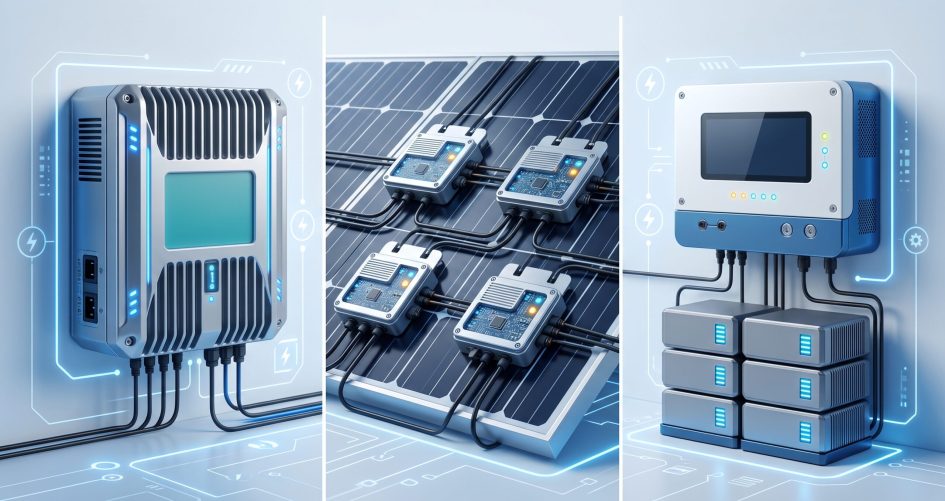
String inverters are one of the most widely used inverter technologies for residential and commercial solar systems. In this setup, multiple solar panels are connected together in a series called a “string.” The electricity from the connected panels is sent to a central inverter, which converts the DC power into AC electricity.
String inverter systems are popular because they provide a simple and cost-effective solution for many solar installations.
String inverters are often a strong choice for properties with simple roof designs and consistent sunlight throughout the day.
Microinverters are compact inverters installed directly on individual solar panels. Instead of sending DC electricity from multiple panels to one central inverter, each panel converts its own electricity into AC power.
This panel-level approach allows each solar module to operate independently, making microinverters especially useful for homes with complex roof designs or partial shading.
Microinverters are commonly selected for residential installations where maximizing energy production and monitoring capability are priorities.
Hybrid inverters combine solar inverter functions with battery storage management. They allow solar panels, batteries, household loads, and the electrical grid to work together in one integrated system.
As battery storage becomes more popular in the United States, hybrid inverters are increasingly used for homeowners who want backup power and greater control over their energy usage.
| Feature | String Inverter | Microinverter | Hybrid Inverter |
|---|---|---|---|
| Installation Method | One central inverter for multiple panels | One inverter installed per panel | Central inverter with battery management features |
| Initial Cost | Low to moderate | Higher | Moderate to high |
| Energy Optimization | System-level optimization | Panel-level optimization | Solar and battery optimization |
| Shade Performance | Moderate to limited | Excellent | Depends on system design |
| Battery Compatibility | Requires additional equipment | Requires compatible solutions | Designed for battery integration |
| Best Application | Simple rooftops and commercial projects | Residential systems with complex layouts | Solar plus storage systems |
| Specification | String Inverters | Microinverters | Hybrid Inverters |
|---|---|---|---|
| Typical Power Range | 1 kW–100 kW+ | 200W–500W per panel | 3 kW–30 kW+ |
| Efficiency Range | 95%–99% | 95%–98% | 95%–99% |
| Typical Warranty | 5–15 years | 10–25 years | 5–15+ years |
| Monitoring Level | System monitoring | Individual panel monitoring | System and battery monitoring |
| Maintenance | Centralized servicing | Panel-level servicing | Centralized servicing |
| Common Users | Homes, businesses, solar farms | Residential customers seeking maximum flexibility | Homes and businesses with storage needs |
Your roof layout plays a major role in inverter selection. Homes with a single roof direction and minimal shading may perform well with string inverters. Properties with multiple roof angles or shading challenges may benefit from microinverter technology.
If you want backup power or plan to install batteries, a hybrid inverter can simplify the process by combining solar conversion and battery management.
Selecting the correct inverter requires evaluating your current energy needs and future goals. Consider the following steps before making a purchase.
Review your roof shape, sunlight conditions, and available installation space. A straightforward roof may not require advanced optimization features, while a complex design may benefit from microinverters.
String inverters usually provide the most affordable solution, while microinverters and hybrid systems offer additional features at a higher cost.
If you plan to add batteries, choose an inverter system that supports storage. Hybrid inverters are designed specifically for solar-plus-battery applications.
Always compare warranty coverage, manufacturer reputation, efficiency ratings, and technical support before selecting an inverter.
Emston Tech provides dependable solar equipment options to help customers select inverter solutions that match their system requirements.
The best option depends on your installation. String inverters are often more affordable and work well for simple systems, while microinverters provide better performance in shaded or complex roof environments.
Hybrid inverters can be valuable for customers who want battery storage, backup power, or greater control over their energy usage. Their benefits depend on your specific energy goals.
Solar inverter lifespan varies by technology and manufacturer. Many traditional inverters operate for around 10–15 years, while some microinverters offer longer warranty coverage.
Battery compatibility depends on your current inverter and system design. Some systems may require a hybrid inverter or additional equipment to support energy storage.
Understanding the differences between string, micro, and hybrid inverters helps you create a solar system that delivers reliable performance and long-term value. String inverters provide an affordable and proven solution, microinverters offer advanced panel-level optimization, and hybrid inverters support the growing demand for solar battery storage.
Whether you are installing a new solar system or upgrading your existing setup, Emston Tech offers quality solar equipment designed for modern energy needs.
Explore Emston Tech’s inverter solutions today and choose the technology that helps you build a more efficient, reliable, and future-ready solar energy system.